About Dataset
B2B Lead Scoring Dataset — Intermediate Tier
This is a synthetic dataset for practicing B2B lead scoring. It was generated by leadforge, an open-source Python framework for producing realistic CRM/funnel training data. No real company, customer, or transaction is represented.
What you are predicting: Each row is a sales lead at a fictional B2B SaaS company. The task is binary classification:
converted_within_90_days— did this lead close as a paid deal within 90 days?
Features capture the first 30 days of CRM activity per lead (email/call touches, product sessions, deal stage, account firmographics). The label is derived from simulated events — never directly sampled — so there is genuine causal structure behind the signal.
This tier: intermediate
| Property | Value |
|---|---|
| Conversion rate | ~22% |
| Signal strength | 0.70 / 1.0 (medium) |
| Noise level | 0.30 / 1.0 (moderate) |
| Missing values | ~8% |
| LR AUC (test, 5-seed median) | 0.662 |
| GBM AUC (test, 5-seed median) | 0.634 |
| Average precision (LR) | 0.332 |
| Precision @100 | 0.33 |
The intermediate tier is the default benchmark. Conversion rate is ~22% — more realistic for B2B SaaS than the intro tier — and noise is moderate enough that simple feature engineering starts to matter. GBM does not consistently beat logistic regression here (the snapshot is dominated by near-linear features); that gap is worth investigating. Calibration becomes important at this prevalence — a model that predicts the right rank order can still be badly miscalibrated.
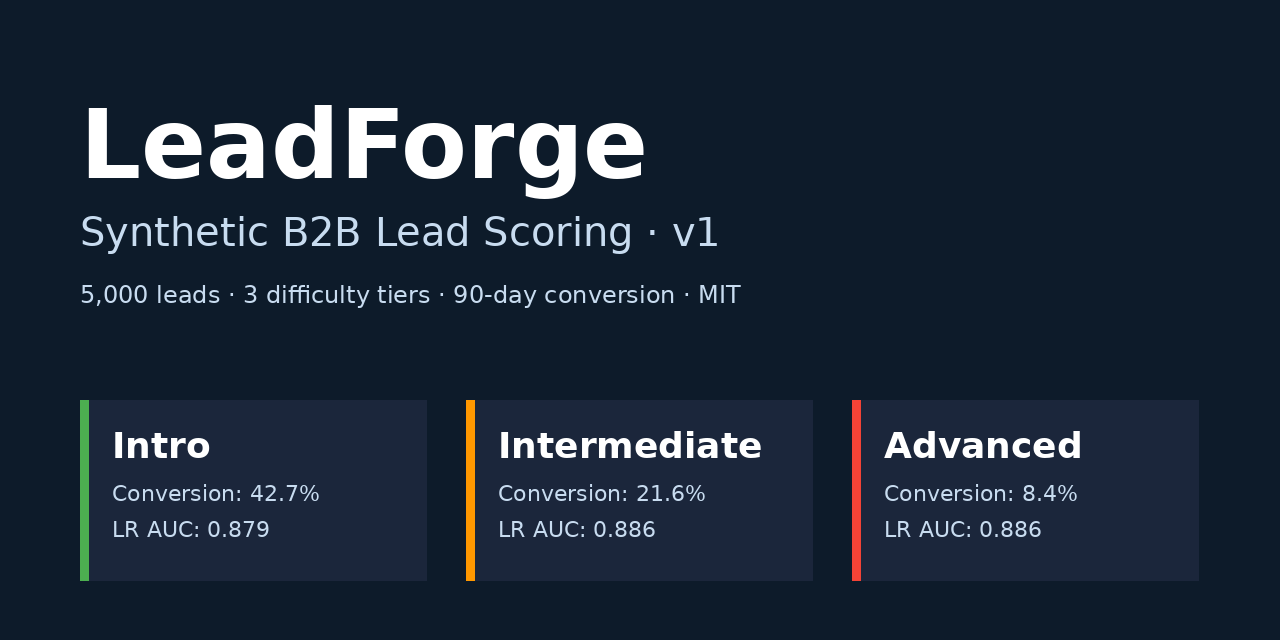
This dataset ships in three tiers — intro → intermediate → advanced — with decreasing signal, lower conversion rates, and heavier noise and missingness. All three tiers share the same schema and simulate the same fictional B2B world.
Table inventory
| Table | Rows | Description |
|---|---|---|
| accounts | 1,500 | One row per company |
| contacts | 4,200 | One row per buyer-side individual (multiple per account) |
| leads | 5,000 | One row per lead — the prediction unit |
| touches | 38,724 | Marketing / SDR outreach events (first 30 days per lead) |
| sessions | 10,012 | Product demo or trial sessions (first 30 days per lead) |
| sales_activities | 20,679 | CRM activities: calls, emails, meetings (first 30 days per lead) |
| opportunities | 4,255 | Deal records opened before the 30-day snapshot |
Snapshot-safe: event tables contain only rows with timestamps ≤ 30 days from lead
creation. Outcome columns (converted_within_90_days, conversion_timestamp,
close_outcome) are excluded from the public relational tables — they appear only in the
task splits.
Features
| Category | Columns | Examples |
|---|---|---|
| Account | 6 | account_id, industry, region |
| Contact | 4 | contact_id, role_function, seniority |
| Lead metadata | 3 | lead_id, lead_created_at, lead_source |
| Engagement | 11 | touch_count, inbound_touch_count, outbound_touch_count |
| Sales | 6 | activity_count, days_since_last_touch, opportunity_created |
| Target | 1 | converted_within_90_days |
⚠ Intentional leakage trap: total_touches_all aggregates touches over the full
90-day window (not just the 30-day feature window) and is deliberately retained as a
leakage-detection teaching exercise. It is flagged leakage_risk=True in
feature_dictionary.csv. Drop it from your feature set unless you are studying leakage.
See feature_dictionary.csv for the full column-by-column specification.
The simulated world
The dataset simulates a fictional company — Veridian Technologies — a Series B startup (Austin, TX, founded 2017) selling Veridian Procure, a cloud procurement / AP automation SaaS. Everything below is invented:
- Target customers: 200–2,000-employee firms in the US and UK (manufacturing, logistics, healthcare, professional services)
- Deal range: $18,000–$120,000 ACV; average deal $42,000; average sales cycle 45 days
- Go-to-market: 45% inbound marketing, 35% SDR outbound, 20% partner referrals
- Buyer personas: VP Finance (economic buyer), AP Manager (champion), IT Director (technical evaluator), Procurement Manager (end user)
In this public version, the hidden causal graph, latent trait scores, and mechanism parameters are withheld. The instructor companion bundle includes them.
How to load
import pandas as pd

# Flat CSV — all leads, all splits combined (convenient for exploration)
df = pd.read_csv("lead_scoring.csv")
X = df.drop(columns=["converted_within_90_days"])
y = df["converted_within_90_days"]

# Parquet task splits — recommended for model training
train = pd.read_parquet("tasks/converted_within_90_days/train.parquet")
valid = pd.read_parquet("tasks/converted_within_90_days/valid.parquet")
test  = pd.read_parquet("tasks/converted_within_90_days/test.parquet")

# Relational tables — for feature engineering
leads   = pd.read_parquet("tables/leads.parquet")
touches = pd.read_parquet("tables/touches.parquet")
Splits are 70 / 15 / 15 (train / valid / test), stratified on the target, deterministic given seed 42.
Note on account overlap: ~93% of test-set accounts also appear in the training set
(splits are keyed on lead_id). Headline AUC overstates generalisation to unseen
accounts. For a faithful out-of-sample estimate, use
GroupKFold(groups=df["account_id"]).
Reproducibility
Generated with leadforge v1.0.0, recipe b2b_saas_procurement_v1, seed 42,
difficulty intermediate. To reproduce:
pip install leadforge
leadforge generate --recipe b2b_saas_procurement_v1 --seed 42 \
                   --mode student_public --difficulty intermediate --out my_bundle
Every file in this bundle is SHA-256 hashed in manifest.json. Run
leadforge validate my_bundle to verify integrity.
Author: Shay Palachy Affek · Kaggle · GitHub
Caveats
- Synthetic data only. No real company, customer, or market is represented.
- AUC does not distinguish tiers. LR AUC is ~0.66 across all three tiers by design. The tiers differ in conversion rate (43% / 22% / 8%), noise, and missing values — not in rank discrimination. Use average precision, P@K, and calibration metrics to see the difficulty gradient.
- ~93% train/test account overlap. Splits are keyed on
lead_id; most test accounts also appear in train. Headline metrics overstate generalisation to unseen accounts. - Snapshot window. Engagement features cover days 0–30 per lead; the label resolves
at day 90.
total_touches_allis the intentional exception — it aggregates over the full 90-day window and is a leakage trap. - Public version. The hidden causal graph, latent trait scores, and mechanism parameters are withheld. The instructor companion bundle includes them.